

The Shift from Hardware to Intelligence
For a long time, the energy conversation was dominated by generation: how many gigawatts of solar or wind we could add to the grid. But in 2026, the focus has shifted. As renewable penetration reaches record highs, the challenge isn’t just making energy—it’s managing it.
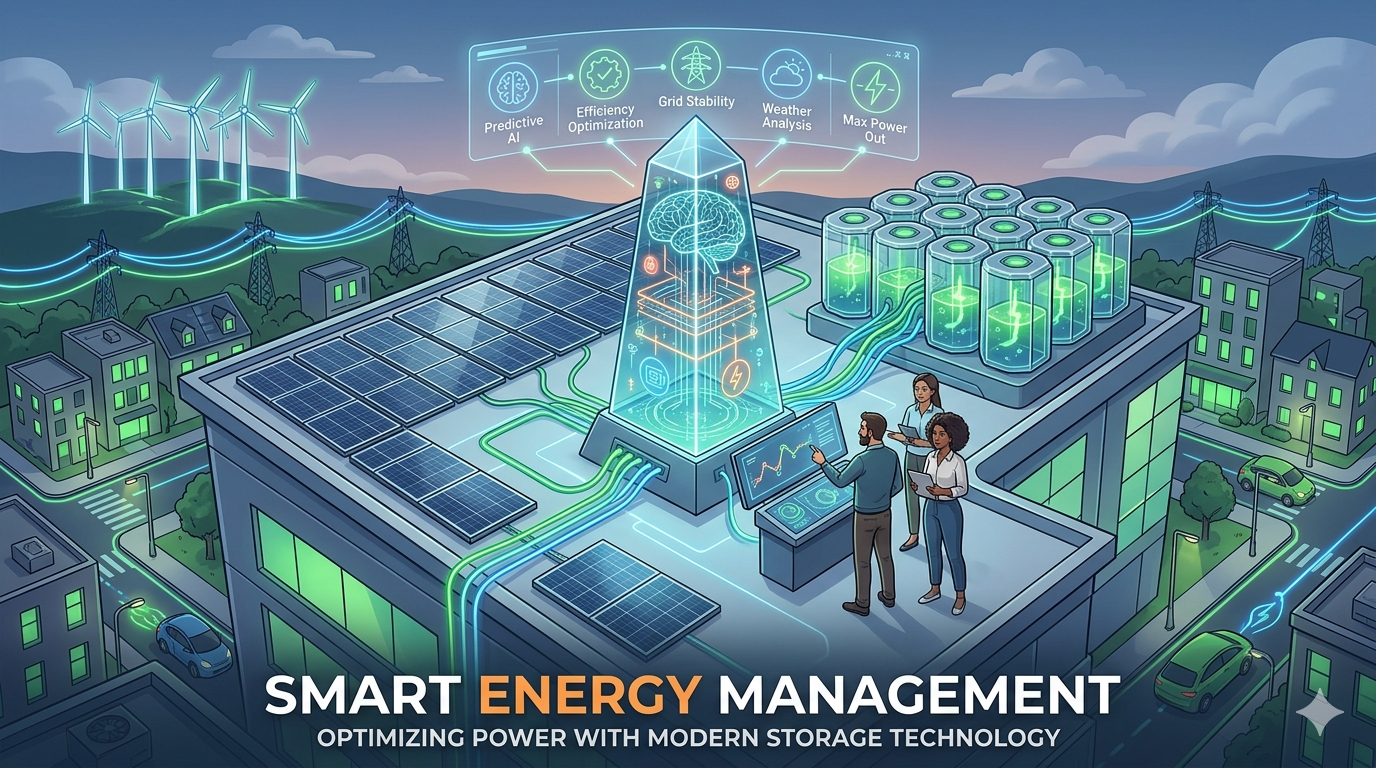
Smart Energy Management Systems (SEMS), powered by cutting-edge storage technology and Artificial Intelligence, have transitioned from a luxury for tech-forward companies to a mechanical necessity for the modern grid. By 2026, energy storage is no longer just a “backup battery”; it is the “virtual transmission” asset that stabilizes the global power infrastructure.
The Anatomy of Modern Smart Storage
The “smart” in smart energy management comes from the integration of Battery Energy Storage Systems (BESS) with cloud-based AI. Unlike traditional systems that relied on static rules, modern SEMS use real-time data to make autonomous decisions.
1. Advanced Battery Chemistries: Safety and Longevity
In 2026, Lithium Iron Phosphate (LiFePO4) has become the industry standard for stationary storage. Unlike older chemistries, LiFePO4 offers superior thermal stability—virtually eliminating the risk of fire—and a much longer lifecycle, often exceeding 10,000 cycles. For businesses, this translates to a lower Total Cost of Ownership (TCO) and a system that lasts for decades rather than years.
2. Modular and Containerized Solutions
The days of custom-building battery rooms are over. Modern storage is modular and containerized. These “plug-and-play” units allow companies to start small and scale their capacity as their energy needs grow. This modularity reduces on-site labor costs and allows for rapid deployment, which is critical as the surge in EV charging loads puts immediate pressure on local transformers.
Key Strategies for Optimization
How exactly does a smart system “optimize” power? It utilizes three primary strategies to turn a passive battery into an active revenue generator.
Peak Shaving: Cutting the Expensive Spikes
Most industrial and commercial utility bills are dictated by “demand charges”—expensive surcharges triggered when a facility draws a large amount of power at once.
- The Smart Move: The SEMS monitors the facility’s load in real-time. When it detects a spike that would trigger a demand charge, it instantly discharges the battery to “shave” that peak.
- The Result: The utility company sees a flat, consistent draw, and the business sees a significant reduction in their monthly bill.
Load Shifting and Time-of-Use (TOU) Arbitrage
Electricity prices fluctuate throughout the day. In 2026, with widespread dynamic pricing, energy might be cheap at 2:00 PM (high solar production) but incredibly expensive at 7:00 PM.
- The Smart Move: The AI-driven system automatically charges the batteries when prices are lowest and discharges them when prices peak.
- The Result: The system effectively “buys low and sells high,” reducing the net cost of energy without changing the facility’s operational habits.
Grid Stabilization and Frequency Regulation
The grid must maintain a precise frequency (50Hz or 60Hz) to operate safely. When demand suddenly surges, the frequency drops.
- The Smart Move: Modern BESS can react in milliseconds—far faster than a traditional gas peaker plant. They can inject or absorb power to balance the grid’s frequency.
- The Result: In many markets, utility companies actually pay BESS owners for this “ancillary service,” turning the storage system into a secondary stream of income.
AI: The Brain of the System
In 2026, the most valuable part of an energy system isn’t the lithium inside the battery; it’s the Machine Learning (ML) algorithm managing it.
Modern SEMS utilize three types of learning to maximize efficiency:
- Predictive Analytics: By analyzing weather forecasts and historical usage, the AI predicts exactly how much solar energy will be available tomorrow and how much the facility will need.
- Anomaly Detection: The system monitors every cell in the battery array. If one cell begins to show a slightly different voltage or temperature profile, the AI identifies it as a potential failure point before it actually breaks. This Predictive Maintenance extends equipment life and prevents downtime.
- VPP Integration: Thousands of individual smart storage units can be linked together into a Virtual Power Plant (VPP). Together, they act as a single, massive power plant that can support the grid during emergencies, with the AI handling the complex coordination of thousands of devices.
Case Study: The 2026 Industrial Shift
A mid-sized logistics center recently integrated a modular 500kWh BESS with its existing solar array. By using AI to coordinate EV fleet charging with solar production and peak shaving, the center reduced its grid dependency by 65% and saw a full ROI on the storage hardware in just under four years.
Conclusion: Investing in Intelligence
Smart Energy Management is the final piece of the renewable energy puzzle. It takes the variable, unpredictable power of nature and turns it into a steady, reliable, and profitable asset. As we move deeper into 2026, the question for businesses is no longer “should we add storage?” but “how smart is our storage?”
By combining modern BESS hardware with AI-driven intelligence, we are creating a future that is not just green, but resilient, autonomous, and incredibly efficient.
Ready to optimize? Explore our latest Renewable Energy Storage Solutions and see how a smarter grid can power your bottom line.