


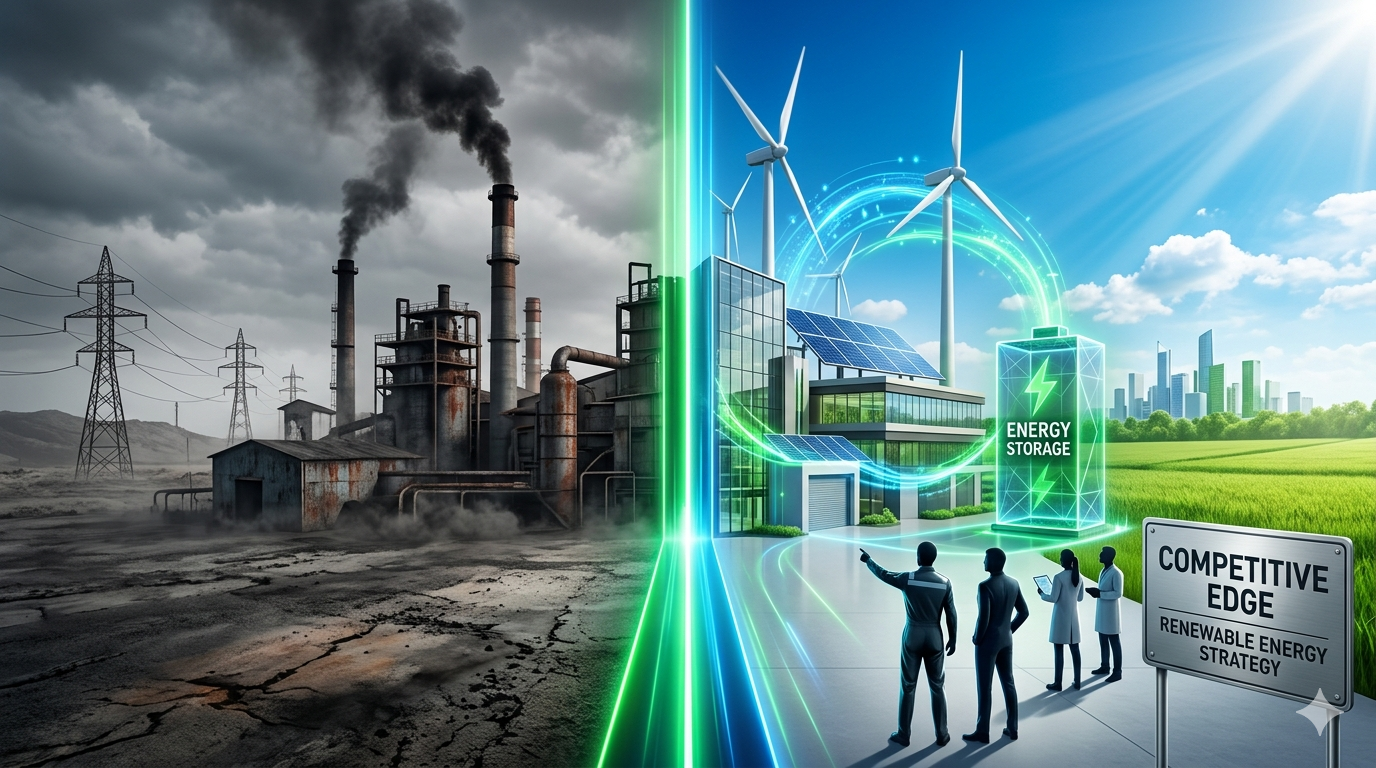
For decades, the conversation around renewable energy in the corporate world was centered on “corporate social responsibility” (CSR). It was seen as a “nice-to-have” addition to an annual report—a way to signal environmental consciousness to shareholders. However, the global economic landscape has shifted dramatically. Today, transitioning to a Renewable Energy Storage Solution is no longer just about being a good global citizen; it is a hard-nosed, strategic business move designed to protect margins, ensure operational continuity, and secure a competitive advantage.
For heavy industry and commercial enterprises, the integration of Solar, Wind, and Storage offers a pathway to decouple growth from volatile fossil fuel markets. Here is how the transition to a hybrid energy model is redefining industrial efficiency and profitability.
1. Eliminating Energy Volatility and Price Spikes
The most significant threat to industrial stability is the volatility of the global energy market. Natural gas and oil prices are subject to geopolitical tensions, supply chain disruptions, and carbon pricing fluctuations. For a business with high energy demands, a 20% spike in utility costs can erase an entire quarter’s profit margins.
By investing in an on-site hybrid system—boasting our benchmark 92% Hybrid Energy efficiency—businesses effectively “lock in” their energy costs for the next 20 to 25 years. Once the infrastructure is installed, the marginal cost of the energy produced by the sun and wind is effectively zero. This transforms energy from a variable, unpredictable expense into a fixed, manageable asset.
2. Peak Shaving and Demand Charge Management
For many industries, the utility bill isn’t just based on how much energy they use, but when and how fast they use it. “Demand charges” are heavy fees applied by utility companies to customers who draw large amounts of power during peak grid hours.
This is where the Storage component of a hybrid system becomes a financial powerhouse. Through a process called Peak Shaving, the system monitors the facility’s power draw. When the machinery begins to pull high levels of power that would trigger a demand charge, the AI-managed battery system kicks in, discharging stored solar or wind energy to “shave” the peak. The utility company sees a flat, consistent draw, and the business saves thousands of dollars every month in avoided surcharges.
3. Operational Resilience and “Energy Sovereignty”
In the era of climate-driven weather extremes, grid reliability is declining. For a manufacturing plant, a data center, or a cold-storage facility, a power outage is more than an inconvenience—it is a catastrophic financial event involving lost inventory, damaged equipment, and idle labor.
A hybrid energy system provides Energy Sovereignty. By operating a microgrid capable of “islanding” (disconnecting from the main grid during a failure), an industrial site can maintain 100% uptime. Our 85% Wind Turbine efficiency ensures that even during a storm where solar panels are obscured, the kinetic energy of the wind is being captured and stored, keeping critical production lines moving while competitors are left in the dark.
4. Meeting the “Green Supply Chain” Mandates
We are entering an era of radical transparency. Large multinational corporations (like Apple, Google, and Walmart) are now requiring their entire supply chains to prove their carbon neutrality. If your business is a mid-tier supplier, your ability to provide “green” manufactured goods is no longer a bonus—it is a requirement to keep your contracts.
Industrial energy storage solutions allow businesses to claim a Net-Zero status for their production. This “Green Premium” allows companies to win more contracts, enter stricter European and North American markets, and often command higher prices for their sustainably produced goods.
5. Future-Proofing Against Carbon Taxation
Governments worldwide are rapidly implementing carbon taxes and “Border Adjustment Mechanisms.” These policies penalize companies with high carbon footprints. By transitioning to a hybrid renewable system now, industries are future-proofing their operations against upcoming legislation.
Instead of paying a “penalty” for using fossil-fuel-heavy grid power, businesses can reinvest those funds back into their own technological upgrades. Transitioning early allows a company to move down the “learning curve” ahead of its competitors, mastering the management of hybrid systems before they become a mandatory standard.
6. Attracting Talent and Investment
The modern workforce, particularly Millennials and Gen Z, prioritizes working for companies that align with their values. A factory powered by wind and solar is a powerful recruitment tool for top-tier engineering and management talent.
Furthermore, the investment community has pivoted toward ESG (Environmental, Social, and Governance) criteria. Green-certified companies often have access to lower-interest “Green Loans” and are more attractive to private equity and venture capital. The capital markets are signaling clearly: the future of industry is renewable, and capital will flow toward the most efficient adopters.
Conclusion: From Cost Center to Profit Center
For over a century, energy has been viewed by industry as a “necessary cost”—an unavoidable drain on the balance sheet. Hybrid energy systems flip this narrative. By combining the natural power of the wind and sun with the strategic precision of advanced storage, energy becomes a Strategic Asset.
At our company, we don’t just provide equipment; we provide the foundation for industrial longevity. With 92% Hybrid Energy efficiency, we enable businesses to stop reacting to the energy market and start leading it. The transition to renewables isn’t just about saving the planet—it’s about ensuring your business is one of the ones left standing in the economy of tomorrow.