


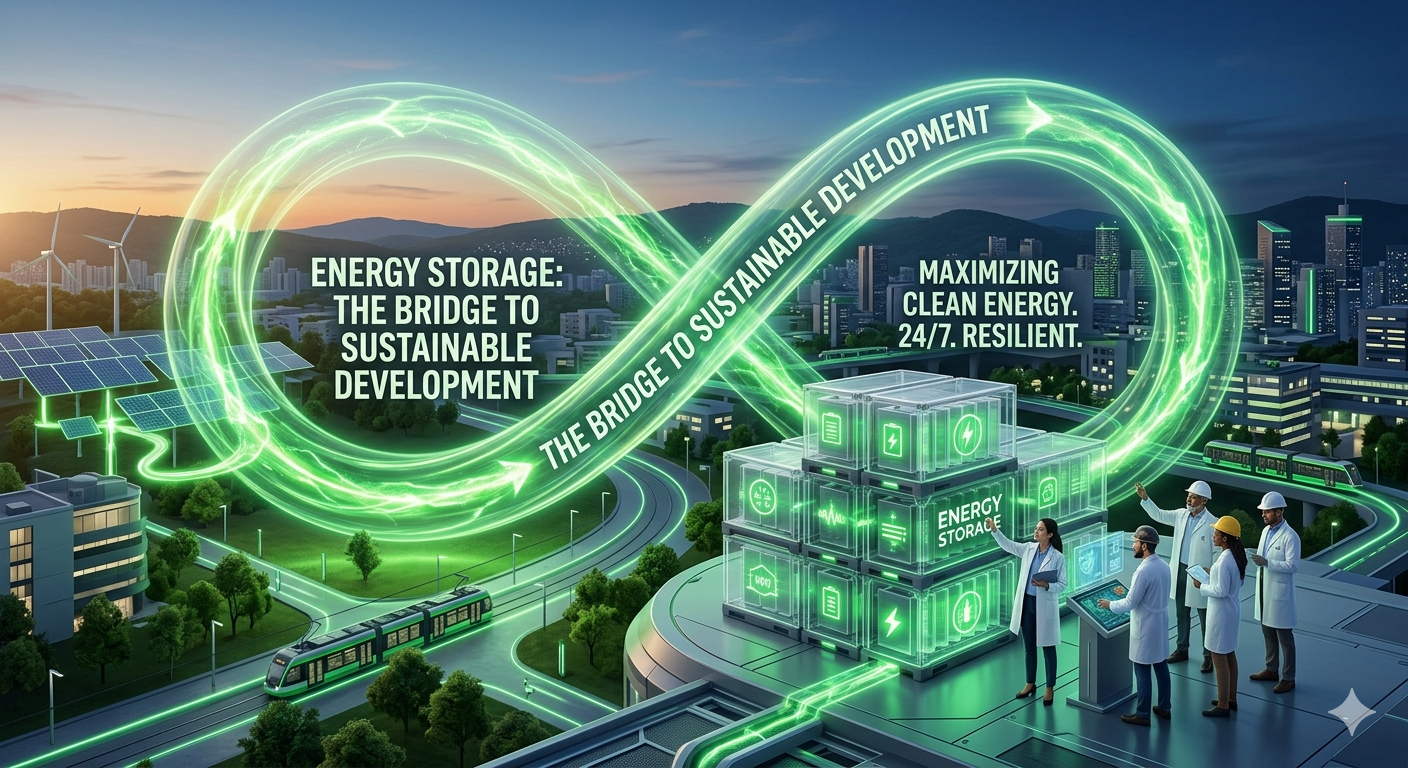
The Silent Engine of the Green Revolution
The global shift toward sustainability is often visualized by vast fields of blue solar panels and towering white wind turbines. While these are the visible icons of the energy transition, there is a silent, less conspicuous technology working behind the scenes that determines whether this transition succeeds or fails: Energy Storage.
Sustainable development, as defined by the United Nations, requires meeting the needs of the present without compromising the ability of future generations to meet theirs. In the context of energy, this means moving away from finite, polluting fossil fuels toward infinite, clean sources. However, because nature does not provide energy on a fixed human schedule, storage is not just a “bonus” feature—it is a fundamental requirement for a sustainable planet.
Bridging the Intermittency Gap
The primary challenge of renewable energy is intermittency. Solar energy peaks at midday, while wind energy can be unpredictable, often peaking during off-peak hours. Unfortunately, human energy demand follows a different pattern, usually spiking in the early morning and late evening when people are home.
Without storage, a significant portion of clean energy produced during peak sun or wind hours goes to waste—a process known as curtailment. Energy storage solutions, ranging from massive lithium-ion battery arrays to innovative flow batteries, act as a bridge. They “time-shift” energy, capturing the surplus from the afternoon and delivering it during the evening peak. This ensures that every photon of sunlight and every gust of wind captured is utilized, maximizing the efficiency of our natural resources.
The Triple Bottom Line of Storage
To understand why storage is essential for sustainable development, we must look at it through the lens of the “Triple Bottom Line”: Economic, Environmental, and Social impact.
1. Environmental: Decarbonizing the “Peaker” Plants
Currently, when energy demand spikes beyond what renewables can provide, utilities turn on “peaker plants.” These are typically gas-fired plants that can start quickly but are highly inefficient and emit high levels of CO2. Energy storage replaces the need for these polluting plants. By discharging clean, stored energy during demand spikes, storage allows us to keep the grid “green” 24 hours a day, drastically reducing the total carbon footprint of our infrastructure.
2. Economic: Reducing Infrastructure Costs
Building new power lines and substations to handle peak loads is incredibly expensive. Energy storage provides a solution known as “Non-Wires Alternative” (NWA). By placing storage units at strategic points in the grid, we can manage local demand without digging up land for new cables. Furthermore, for businesses, storage reduces “demand charges”—the expensive fees utilities charge for high power usage during peak times—leading to a direct improvement in the bottom line.
3. Social: Energy Security and Equity
Sustainable development is impossible without energy security. In developing nations or disaster-prone areas, a grid failure can mean the loss of life-saving medical services or clean water pumping. Energy storage provides a safety net. It allows communities to maintain essential services during outages, fostering a more resilient and equitable society where access to power is not a luxury, but a guaranteed right.
Beyond Batteries: The Diversity of Storage Tech
While lithium-ion technology dominates the headlines, sustainable development requires a diverse portfolio of storage technologies to suit different needs:
- Short-Duration Storage: Ideal for frequency regulation and quick bursts of power (e.g., high-performance lithium-ion).
- Long-Duration Storage (LDES): Technologies like pumped hydro, compressed air, or flow batteries that can provide power for 10+ hours. This is crucial for surviving multi-day weather events where sun and wind are absent.
- Thermal Storage: Capturing heat (often in molten salts or specialized bricks) to be used later for industrial processes or heating, decarbonizing sectors that electricity alone cannot reach.
The Circular Economy of Energy Storage
A common critique of energy storage is the environmental impact of mining minerals like lithium and cobalt. However, the energy storage industry is at the forefront of the Circular Economy.
Sustainable development in this sector involves “Second-Life” applications—where batteries from electric vehicles (EVs), which are no longer powerful enough for cars, are repurposed for stationary grid storage. Once these batteries reach the end of their second life, modern recycling techniques allow for the recovery of up to 95% of the raw materials, creating a closed-loop system that minimizes mining and waste.
Strategic Integration: Achieving 92% Efficiency
As our company’s data suggests, achieving 92% Hybrid Energy efficiency is only possible when storage is integrated at the design phase. It is the component that allows wind turbines to keep “working” even when the air is still and solar panels to “shine” at midnight. By stabilizing the flow of power, storage reduces the mechanical stress on turbines and the electrical stress on transformers, extending the life of the entire renewable ecosystem.
Conclusion: The Foundation of a Green Future
Sustainable development is a puzzle with many pieces—policy, technology, and social will. But without energy storage, the puzzle will never be complete. Storage is the “glue” that holds a renewable grid together, turning variable natural forces into a reliable, steady pulse for modern civilization.
As we continue to innovate in Renewable Energy Storage Solutions, we aren’t just selling batteries; we are selling the insurance policy for the planet’s future. By investing in storage today, we ensure that the green revolution is not just a temporary trend, but a permanent foundation for generations to come.